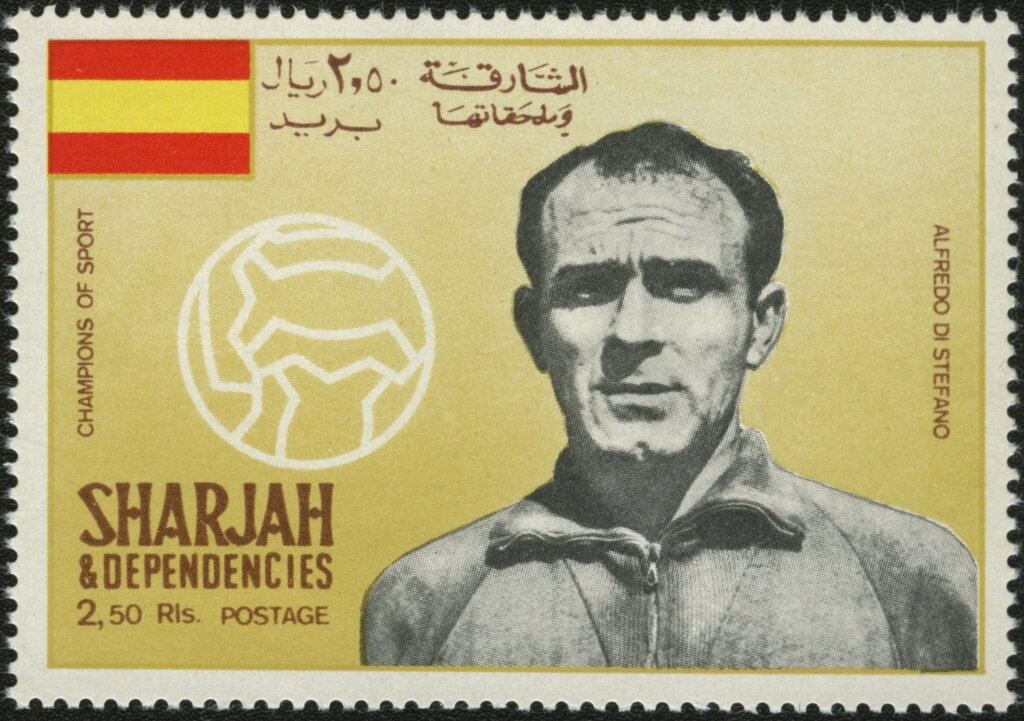
Alfredo Di Stéfano
Five consecutive European Cups, one man who made the trophy feel inevitable.

via Wikipedia: Alfredo Di Stéfano · see source
An Argentine-born forward who became a Spanish citizen and spent his defining years at Real Madrid, he possessed a completeness of skill rarely seen in the game: elite dribbling, surgical passing, relentless work-rate, and a finishing touch that made him the engine of the most dominant club side the competition has ever known. In the five consecutive European Cup triumphs of 1956 through 1960, Di Stéfano was not merely a participant but the gravitational centre of every attacking phase. His name became synonymous with the trophy itself, and in Spain, the Di Stéfano Trophy — awarded by the newspaper Marca to the best player in La Liga — carries his surname to this day. For fans and historians, he is less a statistic than an era.
- Role
- Forward / Attacking all-rounder
- Club (European Cup era)
- Real Madrid
- Nationality
- Argentine-Spanish
- Playing era
- Mid-1950s to early 1960s
Verified Timeline
Lore & Background
In the mid-1950s, European club football was a rough, regional affair. The European Cup, inaugurated in 1955-56, was a two-legged knockout gauntlet that pitted the champions of each nation against one another. Into this new theatre stepped Real Madrid, and at their heart walked a tall, lean Argentine with a left foot that could bend a free kick around a wall and a right boot that could strike a ball through the centre of a net. Di Stéfano did not simply play in the competition; he redefined what a forward could be within it. Opposing defenders found themselves chasing him across the entire width of the pitch, unable to commit because he could arrive anywhere. The five-year run from 1956 to 1960 remains the competition's most extraordinary single-club dominance. Real Madrid reached five consecutive finals and won all five, a feat no other side has matched. Di Stéfano scored in multiple of those deciders, including the 1956 final and the 1958 final — he found the net in that 3-2 win over AC Milan at the Heysel, with additional goals from Rial (2) and Gento. After the European Cup glory, Di Stéfano's career continued at Espanyol, but the mythology never left Madrid. In 2007, the Spanish newspaper Marca created the 'Di Stéfano Trophy' to honor the best player in La Liga, and his number 9 shirt at the Santiago Bernabéu hangs in the club's museum as a relic of the competition's golden dawn. He died in 2014 at the age of 88, and the football world observed a silence that felt appropriate for a man who had, for five years, made the greatest club trophy in Europe feel like a formality.
In Their Own Story
The floodlights at Wembley hummed like a held breath. It was May 1956, and the air above the pitch tasted of cut grass and cigarette smoke drifting up from the terraces. Di Stéfano stood just outside the box, the ball at his feet, and for a moment the entire stadium seemed to contract to a single point around his shadow. He touched the ball once, twice, let it roll into space, and then — without looking — sent it curling past the Reims goalkeeper into the far corner. Four to three. The Bernabéo faithful, watching by radio across the Channel, erupted. He did not celebrate. He simply jogged back to the centre circle, wiped his forehead with the back of his hand, and waited for the next phase. Five more years of this. Five more finals. The trophy would never look the same without him.
Reader's Guide
The European Cup in its first five seasons was, in every meaningful sense, Di Stéfano's competition. Real Madrid's unbroken run of five titles (1956–1960) is the single most dominant stretch in the tournament's history, and Di Stéfano was the creative and scoring heart of every one. He was not merely a goalscorer in this competition; he was the linking thread. In an era when most forwards operated in isolation, Di Stéfano dropped deep, collected the ball from his full-backs, and launched attacks with a passing range that made him look like a midfielder wearing a striker's number. His partnerships — most famously with Ferenc Puskás — produced a fluid, interchanging front line that opponents simply could not mark. In the finals themselves, Di Stéfano was repeatedly the decisive figure. His 1960 final against Eintracht Frankfurt, a 7-3 rout, is often remembered as the competition's most lopsided decider, and his contributions throughout the campaign that year were relentless. No player has won more European Cups. No player has been more central to the competition's identity in its formative years. The Di Stéfano Trophy, awarded to the competition's top scorer each season, ensures that his name is spoken at the conclusion of every Champions League final to this day.
Did You Know?
- Alfredo Di Stéfano is the only player in history to win five consecutive European Cups (1956–1960), a record that still stands.
- The Di Stéfano Trophy is not a UEFA award for the European Cup top scorer; it is a La Liga award presented by the Spanish newspaper Marca to the best player in the Spanish top flight.
- The 1960 European Cup final, in which Real Madrid beat Eintracht Frankfurt 7-3, remains one of the most lopsided results in the competition's history and was the final chapter of Di Stéfano's five-year reign.
Gallery
Frequently Asked Questions
Who is Alfredo Di Stéfano?
An Argentine-born forward who acquired Spanish citizenship and spent his peak years at Real Madrid, where he became the driving force behind the most dominant club side in European Cup history. His blend of elite dribbling, surgical passing, relentless work-rate, and clinical finishing made him a complete attacking player decades ahead of his era.
What position did Di Stéfano play?
He operated as a forward and attacking all-rounder, meaning he was equally dangerous in creating chances, carrying the ball through midfield, and finishing in front of goal. His relentless engine and vision made him the central hub of Real Madrid's entire offensive system.
How many European Cups did Di Stéfano win?
Five, in consecutive seasons from 1956 through 1960. No other player in the competition's history has matched that unbroken run of titles.
Why is Di Stéfano considered the greatest player in Champions League history?
His name became so intertwined with the trophy that the competition's most prestigious individual award still carries his name to this day. Fans and historians regard him as the gravitational centre of an era when Real Madrid made winning the European Cup feel almost inevitable.
What is Di Stéfano's nationality?
He was born in Argentina but later became a Spanish citizen, giving him a dual Argentine-Spanish identity. This cross-border heritage is a recurring and defining thread in his football story.
More in Legendary Players
Elsewhere in the UEFA Champions League universe
Spotted an error? Know more?
This is a living reference — every entry is fact-audited, and reader corrections feed straight into our audit queue. Suggest an edit · See this site's audit record